





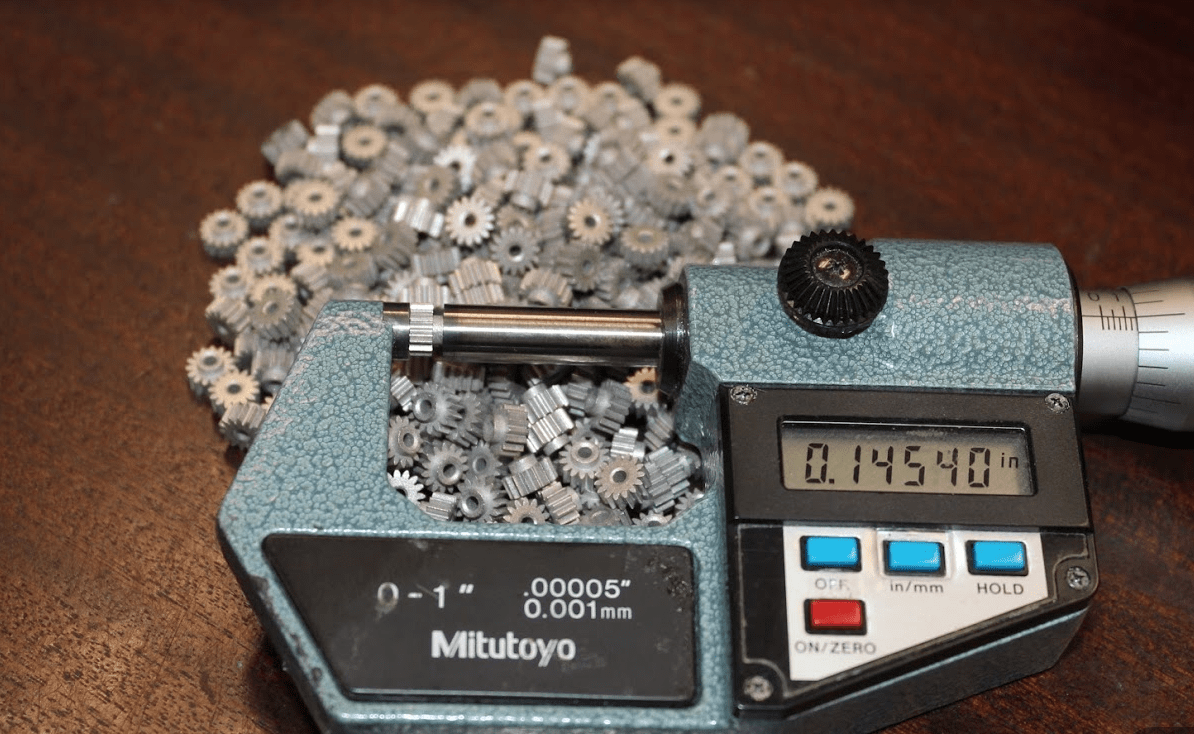
Precision Miniature Powdered Metal Components for Medical Devices
Medical device manufacturers keep pushing toward smaller footprints, whether the end product is a minimally invasive surgical instrument, a wearable drug delivery pump, or a robotic-assisted rehabilitation device. Every reduction in size raises the bar on tolerance, material integrity, and repeatability, and few manufacturing processes handle that combination as reliably as powder metallurgy.
Allied Sinterings is an ISO 13485 compliant custom manufacturer that has specialized in small and miniature powdered metal components since 1959. While many powder metallurgy shops handle a wide range of part sizes, our press capacity, tooling, and inspection equipment are specialized for producing micro and miniature geometries, the scale most medical device programs actually need.
Learn how miniature powder metallurgy satisfies complex medical device design criteria, what material properties and tolerances are achievable, and how our engineering team supports your vendor sourcing process.
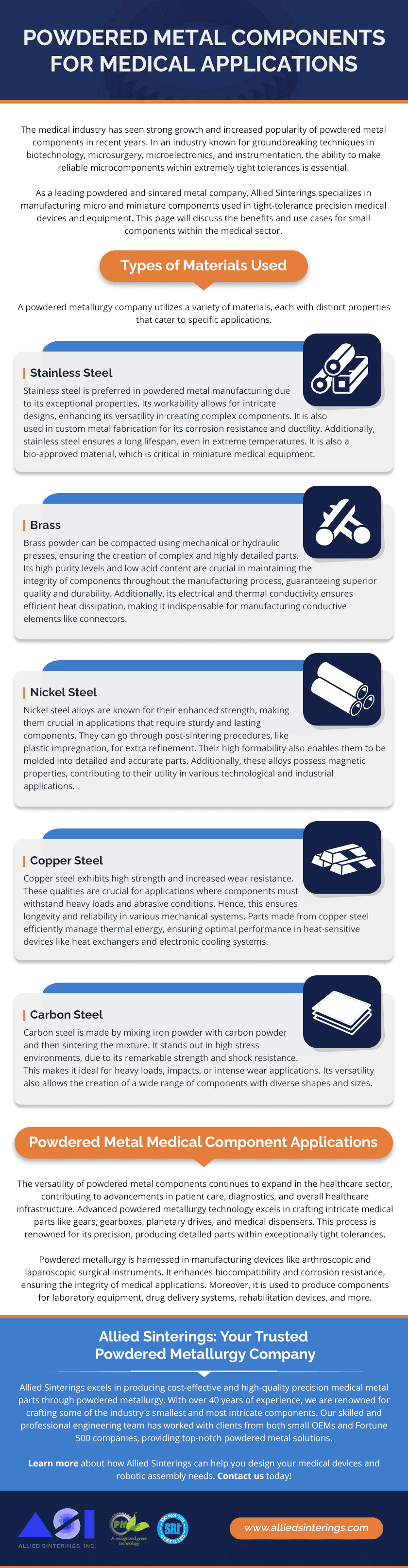
How to Overcome Miniature Medical Device Design Challenges with Powder Metallurgy
Engineers designing surgical instruments, diagnostic equipment, or implantable devices run into common constraints: parts have to be small, precise, and consistent across every production run. Traditional machining can hit tight tolerances on individual parts, but it struggles to hold that consistency at volume without driving up per-part cost.
Powder metallurgy compacts and sinters metal powder into a near-net shape, allowing complex geometries to exit the press near final dimensions. Implementing this process early provides key structural and cost advantages:
- High-volume repeatability. Eliminates the tool wear and unit cost escalation associated with long CNC machining cycles.
- Near-net complex geometries. Form intricate gear teeth, bevel profiles, and internal features with minimal secondary operations.
- Early DFM print reviews. Our DFM review identifies feature conflicts before tool fabrication, preventing costly downstream mold re-cuts. For practical advice on what to do and not do when planning part geometry, download our “Engineer’s Guide to Design Considerations for Powder Metallurgy” ebook.
Medical-Grade Materials & Biocompatibility (304 vs. 316 vs. 420 vs. 440 Stainless Steels)
Material choice carries more weight in medical applications than in almost any other market we serve. 304 Stainless Steel and 316 Stainless Steel remain the two materials engineers specify most often for medical-grade powdered metal components, largely because both resist corrosion from sterilization cycles and bodily fluids while holding up under repeated mechanical stress.
304 Stainless Steel offers strong general corrosion resistance and formability, a common choice for structural and housing components. 316 Stainless Steel adds molybdenum to the alloy, improving resistance to chlorides and more aggressive sterilants, making it a common choice for instruments that undergo autoclaving or chemical disinfection.
In addition to the 300-series options, 420 and 440 Stainless Steel are frequently used for medical instruments that require high hardness and wear resistance. These martensitic grades are best for surgical cutting tools, dental instruments, and wear-intensive components that require a sharp edge and corrosion resistance.
| Stainless Steel Grade | Metallurgical Structure | Corrosion Resistance | Hardness & Wear Resistance | Common Medical Applications |
| 304 | Austenitic | Good (General Purpose) | Low to Moderate | Structural components, housings, non-critical instruments |
| 316 | Austenitic | Excellent (Chlorides & Sterilants) | Low to Moderate | Autoclaved instruments, chemical disinfection applications, implants |
| 420 | Martensitic | Fair to Good | High | Surgical cutting tools, dental instruments, scissors, shears |
| 440 | Martensitic | Good | Very High | Scalpel blades, wear-intensive components, pivot pins, bearings |
We also work with custom-blended powders when a project calls for different mechanical properties, but stainless steel covers the majority of medical device requests we receive.
Core Medical Device Applications: Micro-Gears, Planetary Gear Drives, and Timing Gears
Motion-critical micro-components require tight tolerances to maintain functional repeatability across demanding operational lifecycles. Our miniature powder metallurgy process routinely produces these components for medical devices (this is not an all-inclusive list):
- Miniature fine-pitch gears. Delivers smooth, low-backlash actuation in surgical hand tools and diagnostic equipment.
- Planetary gear drives. Delivers compact torque multiplication within tight housing limits for robotic surgery systems and rehab devices.
- Spinlocks & timing components. Maintains critical internal tolerances to ensure exact dosing accuracy in drug delivery systems.
Miniature Compaction Capabilities & Dimensional Tolerances
Specialized miniature press equipment and dedicated quality inspection tools ensure lot-to-lot dimensional integrity. Allied Sinterings delivers micro-scale components engineered to tight dimensional standards:
- Press tonnage & envelope. Uses 0.5- to 50-ton presses optimized specifically for miniature components up to 1.5 inches in cross-sectional surface area.
- AGMA class 8 tolerances. Achieves precise gearing accuracy verified directly on production runs.
- Comprehensive PM inspection stack. Uses red-line double-flank gear testing, hardness testing, and specialized PM comparators to ensure full-lot compliance beyond simple first-article inspection.
| Capability | |
| Material | SS-304
SS-316 SS-420 SS-440 Custom powder blends |
| Press tonnage | 0.5 to 50 Tons |
| Surface area | Up to 1.5” (cross-section) |
| Tolerances | AGMA Class 8 Gearing |
| Component types | Gears
Gear boxes Planetary gear drives Spinlocks and timing gears Fine-pitch gears Custom gears |
Partner with Allied Sinterings for Your Next Medical Device Build
We built our process around fast, direct communication. Share your part prints and project details with our engineering team early, and we can flag manufacturability concerns before tooling starts rather than after. Contact us to discuss your application or request a quote if you’re ready to move forward with a specific medical device part.
FAQs
What certifications and quality standards does Allied Sinterings maintain for medical components?
Allied Sinterings is ISO 9001:2015 certified and actively aligns its manufacturing processes with ISO 13485 guidelines for medical device components. Contact our engineering team for full documentation or current audit status relative to your project schedule.
What is the smallest tolerance you can hold on medical device components?
We typically hold AGMA Class 8 gearing tolerances on miniature parts, verified through double-flank gear checks and dimensional inspection specific to powder metallurgy.
Can you work from our design before tooling is finalized?
Yes. Our design for manufacturability review happens early in the process, so we can flag potential issues in your print before committing to tooling.
What is a typical lead time for a medical device tooling order?
New tooling orders generally run 6 to 14 weeks depending on part complexity, with faster turnaround on repeat or secondary-process orders.
What materials do you recommend for implantable or sterilizable components?
316 Stainless Steel is our most common recommendation for parts exposed to sterilization or bodily fluids, given its corrosion resistance. 304 Stainless Steel works well for structural components with less aggressive exposure.
